

South Korea Packing List: What to Pack for Your Trip (2026)
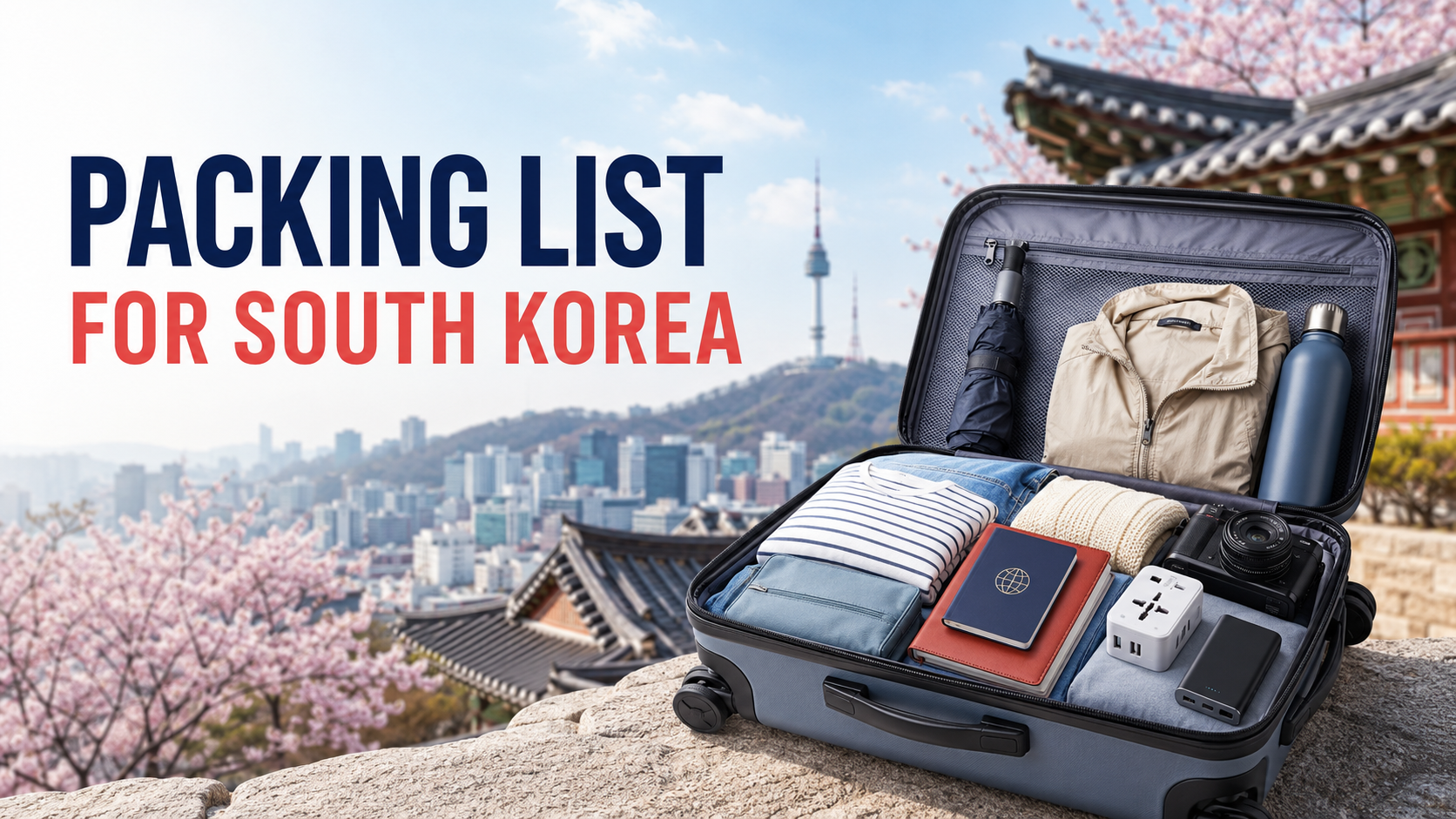
South Korea requires a different packing approach than most destinations. The flight from the US East Coast is around 14 hours; from Europe it's 10–12 hours direct. Either way, the power plugs are different from what most Western travelers are used to, the pharmacies don't carry deodorant, and the fashion culture in Seoul — particularly in areas like Gangnam — means you'll feel out of place in athletic wear everywhere you go.
I learned most of this the hard way. After multiple trips to Korea — from the beaches of Haeundae in Busan to the street food markets of Seoul — I've built a packing system that actually works. This is that list.
Before you start: I use PackMyTrip to build and check off packing lists for every trip. There's a South Korea template you can customize, which is faster than starting from scratch every time.
South Korea Packing List: Quick Reference
| Category | What to Pack |
|---|---|
| Adapter | Type C/F universal adapter (220V) |
| Clothing | Season-appropriate layers, at least 1 nicer outfit |
| Shoes | Comfortable walking shoes that slip on/off easily |
| Toiletries | Bring your own deodorant — hard to find there |
| Tech | Phone, power bank, eSIM or pocket WiFi |
| Meds | Any prescriptions + basic OTC meds from home |
| Documents | Passport, card with no foreign fees, some cash (KRW) |
| Apps | Naver Map, Kakao Taxi, Papago — download before landing |
The Non-Negotiables First
Power Adapter
South Korea uses Type C and Type F plugs at 220V. What you need depends on where you're traveling from:
From the US: Type A/B flat pins don't fit any Korean outlet. You need an adapter — no exceptions. The good news is that most modern electronics (phones, laptops, camera chargers) handle 100–240V, so you only need the plug adapter, not a voltage converter. Check the small print on your charger brick to confirm.
From continental Europe: You're mostly covered. Korean Type C and F sockets use the same round-pin format and the same 220V as most European countries. A standard Type C plug fits directly. Type E plugs (French standard, with a hole in the socket face) may not sit perfectly in Korean Type F outlets — carry a small Type C adapter just in case. UK travelers need an adapter regardless: Type G (three rectangular pins) doesn't fit Korean sockets.
Regardless of where you're from, I carry a universal adapter with two or three USB ports so I can charge my phone, power bank, and camera simultaneously — it removes the guesswork entirely.
Deodorant
This comes up on every Korea travel forum and I can confirm it firsthand: standard Western deodorant is very difficult to find in South Korea. Korean pharmacies (약국) focus heavily on skincare and don't typically stock antiperspirant or deodorant. Convenience stores like GS25 and CU don't carry it either.
Pack enough for your whole trip. If you forget, you might find options in larger expat-focused grocery stores in Seoul, but don't count on it.
Naver Map (Download Before You Land)
Google Maps does not provide proper turn-by-turn routing in South Korea due to geographic data restrictions — it works for basic search but the navigation is unreliable. Download Naver Map before you board your flight. You can save offline maps so it works even before you get a SIM sorted.
For a full breakdown of apps to download before landing, see my guide to essential apps for South Korea.
Clothes: Pack for Your Season
Korea has four genuine seasons and the right clothing varies dramatically depending on when you're going.
Summer (June–August)
Korean summers are brutally hot and humid. Seoul regularly hits 33–35°C (91–95°F) in July and August, with high humidity and a rainy monsoon period that runs through mid-August.
- 5–6 lightweight tops (linen or moisture-wicking fabrics)
- 2–3 lightweight bottoms (shorts, linen trousers, or a skirt)
- 1 light long-sleeve layer (for over-air-conditioned restaurants and the subway)
- 1 compact rain jacket or packable umbrella (monsoon season — or just buy a cheap umbrella at a convenience store for ₩3,000)
- 7+ days of breathable underwear
- Comfortable walking shoes + sandals
My tip: Don't bother bringing a bulky umbrella from home. Every GS25 and CU convenience store sells small umbrellas for about $2.50. If it rains, grab one and leave it when you're done.
Winter (December–February)
Seoul winters are genuinely cold — temperatures frequently drop below -5°C (23°F), and there's occasional snow. Wind off the Han River makes it feel colder than the thermometer says.
- 1 heavy winter coat (waterproof or water-resistant outer layer)
- 2 thermal base layers (wear under everything)
- 3–4 sweaters or mid-layers
- 2 pairs of warm trousers (thick jeans work, but thermal-lined trousers are better)
- Wool socks, warm hat, gloves
- Waterproof boots with grip (sidewalks get icy)
Going between December and February? My South Korea winter packing guide goes deeper on layering, Seoul vs. Busan, and what to buy once you land.
Spring (March–May) and Fall (September–November)
These are the best times to visit — mild temperatures, clear skies, and (in April) cherry blossoms in full bloom. This is the easiest season to pack for.
- 4–5 tops (a mix of short and long-sleeve)
- 1–2 light sweaters or cardigans
- 1 light jacket or trench coat
- 2–3 bottoms
- Layers that peel off as the day warms up
Shoes: The Slip-On Rule
You'll walk a lot in Korea — 20,000+ steps a day in Seoul is normal. Comfort matters more than style. But there's a Korea-specific reason to choose your shoes carefully: many traditional restaurants require you to remove your shoes and sit on floor cushions. Shoes you have to unlace and retie five times a day get old fast.
My recommendation:
- Primary pair: Comfortable walking shoes or sneakers you've already broken in. New shoes in Seoul is a bad idea — the cobblestones around old palaces and markets are uneven.
- Second pair: Sandals in summer, ankle boots or versatile shoes in winter. Something you can go to a nicer dinner in without destroying your feet.
Leave the heels at home unless you have a specific event — the stone paths at places like Gyeongbokgung Palace are genuinely difficult in anything other than flat soles.
Electronics and Tech
| Item | Notes |
|---|---|
| Universal adapter (Type C/F) | Essential — bring one with USB ports |
| Portable power bank | You'll use Naver Map and Kakao all day |
| Extra charging cable | Keep one in your day bag |
| eSIM or pocket WiFi | Order eSIM before departure or rent pocket WiFi at Incheon Airport |
| Camera | Korea is extremely photogenic — the charge cable matters more than the camera body |
SIM Card vs. eSIM vs. Pocket WiFi
You have three options for staying connected:
- eSIM: Easiest. Order one before you leave — I use Saily for Korea and it activates on landing. No physical card to swap, no airport queue.
- Pocket WiFi: Available for rental at Incheon Airport (arrivals hall). Works well and one device can cover a group, but you have to return it and keep it charged.
- Korean SIM card: Also available at the airport and very affordable, but requires a physical SIM swap.
Without data, Naver Map won't function properly and Kakao Taxi won't work at all. This is one case where sorting connectivity before arrival genuinely saves stress.
Toiletries: What to Pack vs. What to Buy There
Korea has some of the best and most affordable skincare and beauty products in the world. Packing your entire skincare routine from home is a waste of luggage space when you can buy better versions for less in any Olive Young (the Korean equivalent of Sephora, but cheaper).
Bring from home:
- Deodorant (see above — non-negotiable)
- Prescription medications in original packaging
- Any specific OTC medications you rely on (ibuprofen, antihistamines, cold medicine — US brands aren't available)
- Contact lenses and solution if you wear them
- Feminine hygiene products if you have a specific preference
Buy when you get there:
- Sunscreen (Korean sunscreens are excellent and much lighter than most Western formulas)
- Sheet masks, skincare, moisturizer
- Basic toiletries (toothpaste, shampoo, etc. — all widely available)
- Umbrella if it rains
My recommendation: pack a small toiletry kit and leave room in your bag for the Olive Young haul on the way home.
Documents and Money
- Passport (valid for at least 6 months beyond your travel dates)
- K-ETA: Many nationalities are currently exempt from the Korea Electronic Travel Authorization for short stays, but this changes — check the current status before you travel
- Credit card with no foreign transaction fees — cards are accepted almost everywhere in Korea, including convenience stores, taxis, and street stalls
- Some cash (Korean Won): Traditional markets like Gwangjang Market in Seoul and many smaller restaurants prefer or require cash. Having ₩50,000–₩100,000 (~$35–$75) on hand is enough
- T-money card: A reloadable transit card used on subways, buses, and some taxis across the country. Pick one up at any convenience store or at the airport and top it up as you go. It's faster than buying individual tickets and works on the Seoul subway and beyond
Flight Essentials (It's a Long One)
The flight to Seoul Incheon (ICN) is long regardless of where you're coming from: around 14 hours from the US East Coast, 10–12 hours from the West Coast, and 10–12 hours from most European hubs (Frankfurt, Amsterdam, London). None of these is a flight you want to arrive at unprepared.
What I keep in my personal item for the flight:
- Neck pillow (inflatable saves space)
- Eye mask and earplugs
- Compression socks (the circulation difference on a 14-hour flight is real)
- Moisturizer and lip balm (cabin air is brutal on long-hauls)
- Noise-canceling headphones or earbuds
- Fresh t-shirt and clean socks to change into before landing — landing in Seoul feeling halfway human makes a difference
- Water bottle (empty through security, fill at the gate)
- Any meds for sleep, motion sickness, or jet lag
What to Buy When You Land
One of the advantages of Korea is that convenience stores (GS25, CU, 7-Eleven) are genuinely excellent — you can get quality snacks, drinks, basic toiletries, phone chargers, and umbrellas at any hour. Olive Young has locations across Seoul and most major cities.
Don't waste bag space on:
- Skincare and sunscreen
- Snacks and drinks
- Umbrellas
- Phone accessories and cables (cheap and widely available)
- Reusable bags (Korean stores charge for plastic — buy one there)
Build This List in PackMyTrip
If you're already working through your packing for Korea, PackMyTrip has packing templates you can customize by trip length and season. Check things off as you go, share the list with travel companions, and add your own items — no starting from scratch for every trip.
Download PackMyTrip → Or see how it compares to eight other packing apps in the full packing list app comparison.
Heading to Busan? Don't miss things to do at Haeundae Beach — or if you're confused about the city's name, here's the full story on Busan vs. Pusan.
Frequently Asked Questions
What should I pack for South Korea?
The essentials for South Korea are a Type C/F universal power adapter (220V), comfortable walking shoes you can slip on and off easily, layers appropriate for the season, your own deodorant (hard to find there), and any prescription medications. Download Naver Map and Kakao Taxi before you land — Google Maps doesn't give proper routing in Korea. For clothes, Koreans dress stylishly especially in Seoul, so pack at least one nicer outfit if you're spending time in Gangnam or Itaewon.
Do I need a power adapter for South Korea?
It depends where you're from. US travelers always need one — Type A/B flat pins don't fit Korean Type C/F sockets, and the voltage difference (110V vs 220V) means you need to confirm your devices are dual-voltage (most modern electronics are). European travelers from continental countries are largely fine — Korean sockets use the same round-pin Type C/F format at 220V, so most European plugs fit directly. UK travelers need an adapter since Type G (three rectangular pins) doesn't fit Korean outlets. A universal travel adapter with USB ports is the safest solution for everyone.
What is hard to find in South Korea?
Deodorant is the most commonly cited hard-to-find item for Western travelers — Korean pharmacies and convenience stores rarely stock it. Also pack your usual prescription medications and any specific OTC medicines you rely on (US brands aren't widely available). Everything else — sunscreen, skincare, face masks, toiletries — is readily available and often much cheaper and higher quality than what you'd bring from home.
What should I NOT pack for South Korea?
Don't bring a full skincare routine — Korean beauty products are world-class and significantly cheaper, so buy what you need there. Skip a bulky umbrella (buy a cheap one at any convenience store if it rains). You also don't need a physical city map — Naver Map handles everything. And leave the formal wear at home unless you have a specific event; Koreans dress smartly but not formally for most nights out.
What should I wear in South Korea?
For summer, lightweight breathable clothes are essential — Seoul gets extremely hot and humid from June through August. For winter, bring a heavy coat, thermals, and waterproof boots as Seoul temperatures regularly drop below freezing. Spring and fall are the best times to visit and call for layers. In general, Koreans dress more formally than many Western countries, so having at least a few non-athletic outfits is worth it, especially in Seoul neighborhoods like Gangnam.
Post Last Updated